Concrete pumping moves fresh concrete from the delivery vehicle to the place where it needs to be poured. For a rear extension, a large floor slab or a site where a mixer cannot get close enough, it can make the difference between an awkward delivery and a manageable working day.
However, hiring a pump is only one part of the plan. The concrete specification, vehicle position, route to the pour, available labour and clean-up arrangements all need to work together. A pump gets material to the work area; your team still needs to place, compact, finish and cure it correctly.
Before booking your next delivery, it helps to understand the options, the questions a supplier will ask and the circumstances in which a simpler delivery method could be enough.
What is concrete pumping?
Concrete pumping is a mechanical method of transporting freshly mixed concrete through a pipeline. Instead of moving repeated wheelbarrow loads from a truck, the concrete is discharged into the pump’s hopper and transferred towards the pour location.
The pipeline may run along the ground or be carried by an articulated boom. The arrangement depends on the site, the obstacles between the vehicle and the work, and the position where concrete is required. Pumping can serve ground-level foundations, basement works and elevated construction, provided the equipment and concrete are suitable.
It is useful to separate concrete supply from concrete placement. The delivery vehicle brings the concrete; the pump transfers it. Even where one company organises both services, they have different space requirements and need a coordinated arrival plan.
How does a concrete pump work?
Many construction concrete pumps use hydraulically driven pistons. Fresh concrete enters a receiving hopper, and the pumping mechanism pushes it into the delivery pipeline. The operator controls the pumping operation while the placing team directs the discharge at the work area.
Before the pour begins, the operator sets up and checks the equipment and prepares the pipeline using the appropriate procedure. Priming helps the concrete travel through the line. Any priming material must be dealt with appropriately so it does not compromise concrete intended for the structure.
The practical sequence is straightforward: prepare the site, position the pump, connect or deploy the delivery system, receive the concrete, pump at an agreed rate, then clean down safely. Each stage takes time, which is why the pumping time alone is not the same as the total hire period.
The rate of placement should suit the people receiving the concrete and the requirements of the structure. Faster discharge is not automatically better. Pouring too quickly can overwhelm a small team or exceed the planned loading and placing sequence.
Types of concrete pumps
Ground line pumps
A line pump delivers concrete through connected pipes and flexible hose sections arranged along an agreed route. This can be useful where the pour is behind a property, through an accessible passage or across a site that the delivery vehicle cannot enter.
The route needs planning rather than a simple straight-line measurement. Corners, gradients, doorways, changes in level and the space required to assemble and handle the line all affect the arrangement. The supplier needs the actual route and site conditions to assess suitability.
Boom pumps
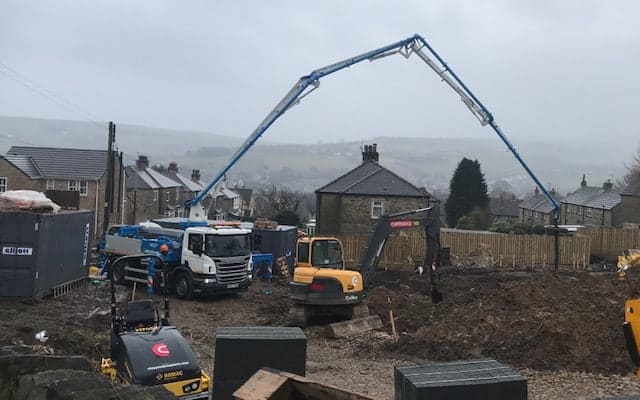
A boom pump carries a delivery pipeline on a hydraulically operated, articulated arm. The boom positions the discharge hose above or near the work area, potentially reaching over an obstacle or serving a higher level.
A suitable standing area is essential. Where stabilisers are required, their footprint and the loads they impose must be considered. Overhead restrictions and the full movement of the boom also matter. A quoted boom length alone does not establish whether a particular setup will reach your pour safely.
Compact and mini pumps
Compact equipment can be helpful where a smaller setup is appropriate. However, “mini” is not a guarantee that the vehicle can enter any driveway or that every concrete mix can be pumped through it. Check dimensions, working space, pipeline requirements and mix compatibility before deciding.
Truck-mounted, trailer-mounted and static arrangements describe how equipment is supported or transported. They do not replace the need to choose a suitable delivery method for the actual job.
Line pumps vs boom pumps: which should you choose?
Start with the route from the proposed vehicle position to the furthest part of the pour. A line pump may be a practical option where a suitable ground route is available. A boom pump may be more appropriate where the concrete needs to pass over an obstruction or reach an elevated work area.
For example, a rear garden foundation with a clear side passage may suit a ground line. A slab behind a building with no usable ground route may call for a boom assessment. Neither example is a firm equipment recommendation without checking the site.
Tell your supplier about both horizontal distance and vertical changes. Include photographs showing the entrance, proposed standing area, route and final pour location. If the site is complex, ask whether a visit is needed before the booking is confirmed.
Our existing advice on choosing the right concrete pump provides further background. The final choice should be based on access, working space, concrete requirements and the planned pour, rather than choosing the biggest or cheapest machine available.
Benefits of concrete pumping
Less repeated movement across the site
Moving concrete in wheelbarrows can involve many journeys, especially where the route is long. Pumping can reduce those trips and the labour needed to transport material, leaving the placing team better able to concentrate on the pour.
A more manageable delivery route
Where direct discharge is impossible, a planned pipeline can bring concrete closer to its final position. This can avoid relying on a narrow or inconvenient wheelbarrow route throughout the delivery.
Better coordination of larger pours
A pump can support an organised placing sequence when delivery intervals and labour are matched to the job. The benefit depends on a reliable concrete supply and a team that can keep pace with the agreed discharge rate.
Potential savings across the whole job
Pumping adds a hire charge, but it may reduce transport labour, delivery delays and disruption. Compare the complete operation rather than treating the pump price as an isolated extra. Savings vary between projects, so a fixed percentage should not be assumed.
Residential applications
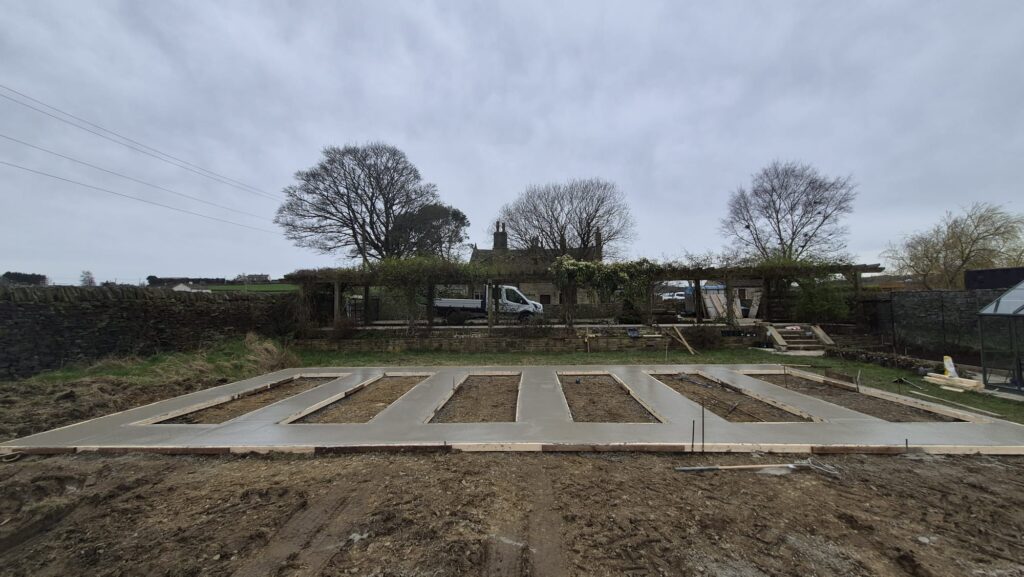
House extensions, garage floors, garden buildings and new home foundations can all present delivery challenges. Often, the concrete volume is manageable but the route is difficult: the work is behind the house, the driveway cannot support a truck, or the entrance is too narrow.
For an extension, discuss the trench layout and the order in which sections will be filled. Identify whether the placing team can move safely around the excavation and whether the pipeline needs repositioning as work progresses.
For a slab, the sub-base, membranes, reinforcement and edge forms should be ready before delivery. The team also needs the right tools and enough people to distribute and finish the concrete. Pump hire does not automatically include those tasks.
Homeowners should also consider neighbours, parked cars, pedestrian access and protection of existing surfaces. Agree the proposed setup early so any necessary access arrangements can be made without a last-minute rush.
Commercial applications
Commercial sites may need pumping for foundations, reinforced slabs, upper floors or work within an existing development. The main challenge is often coordinating a larger operation with other activities taking place nearby.
Agree who controls vehicle movements, who communicates with the pump operator and who is responsible for receiving the concrete. The construction team should confirm the placing sequence and any limits affecting formwork or temporary works.
Delivery intervals matter as much as the pump’s capacity. Too many trucks arriving together can cause congestion, while long gaps can interrupt the pour. The supply schedule should reflect the actual placement rate and site restrictions.
If work must take place outside normal hours, plan staffing, lighting, local restrictions and arrangements for unexpected delays. Our post on night-time concrete deliveries for commercial projects covers these scheduling considerations in more detail.
Concrete pumping on sites with restricted access
Restricted access does not necessarily mean the pump vehicle must enter the same space as the concrete. Sometimes the vehicle can remain at a suitable position while an assessed delivery route reaches the work. However, that position must also allow the concrete supply vehicle to discharge into the pump.
Measure the entrance width and height, and explain any tight turns or steep approaches. Tell the supplier about fragile paving, soft ground, retaining walls, cellars, drains and underground services near the proposed standing area.
A route through or alongside a building needs particular attention to protection, safe access and keeping other people clear. Do not assume a hose can simply be passed through any opening without considering handling space and the consequences of a leak or movement.
If equipment or vehicles would occupy a public road or pavement, establish what permissions and traffic or pedestrian arrangements are required before booking. An available parking space is not, by itself, confirmation that the setup is acceptable.
Health and safety advantages and responsibilities
Reducing repeated wheelbarrow journeys can reduce some manual handling and movement across uneven ground. Pumping can also reduce the need for people to transport wet concrete over long distances. Those benefits depend on a properly planned operation.
Pumps introduce their own hazards, including pressurised pipelines, moving hoses, heavy vehicles and, where fitted, booms and stabilisers. Keep people outside the agreed exclusion areas and follow the operator’s instructions. Blockages, connections and pipeline cleaning must be handled by competent personnel using the approved procedure.
Ground conditions and overhead power lines need assessment before setup. Share information about buried services, voids and other site hazards with the supplier in advance, rather than assuming they will be visible on arrival.
Wet concrete can cause serious skin and eye injuries. Appropriate protective clothing, gloves, footwear and eye protection are needed for the work, together with washing arrangements. Avoid skin contact and do not kneel in fresh concrete. The site team remains responsible for organising safe placing and finishing activities alongside the pump operation.
Does pumped concrete need a different mix?
The supplier must know the concrete will be pumped when the order is placed. Strength alone does not describe everything needed for a suitable mix. Aggregate characteristics, consistence, the pipeline and the intended placement all need consideration.
Provide the concrete specification from the designer or other responsible professional. Explain the application and delivery method so the concrete supplier and pump provider can check compatibility. Structural requirements should not be changed simply to make placing easier.
Do not add water on site to solve a delivery problem without the concrete supplier’s approval and appropriate controls. Uncontrolled changes can affect the material’s performance. If the concrete is not behaving as expected, stop and discuss it with the operator and supplier.
Pumping does not make every concrete self-compacting or remove the need for curing. Unless the specified material and method say otherwise, plan the required compaction, surface finishing and protection after placement.
How much does concrete pumping cost?
There is no single useful price for every project. A quotation needs to reflect the pump, location, access, pipeline arrangement, expected duration and scope of service. Two jobs using the same concrete volume may have very different pumping requirements.
Ask for a written quotation that separates the concrete supply from pumping and identifies what is included. Check the allowed hire period, how additional time is charged and whether the quoted total includes VAT.
Other points to clarify include extra pipeline, site visits, travel, waiting time, cancellation terms and any requirements for cleaning or disposal. Confirm who supplies the placing labour and whether any additional assistance is required for the planned setup.
When comparing quotes, give each company the same site information. A lower headline figure may cover less time or a different scope. The useful comparison is the likely total cost of completing your pour under the actual site conditions.
Calculating quantities and planning the pour
For a rectangular slab, calculate volume by multiplying length by width by depth, with every measurement expressed in metres. A slab measuring 6m by 4m at 0.15m deep has a geometric volume of 3.6m³.
That calculation is a starting point. Actual excavation, irregular edges and changes in level can alter the requirement. Measure the prepared area carefully and discuss a sensible allowance with the supplier rather than ordering from an early drawing alone.
Ask how concrete remaining in the delivery system and any priming material will be allowed for and managed. Avoid applying an arbitrary extra quantity without understanding the proposed setup.
Agree the delivery time only after checking site readiness and labour availability. Have tools, access, protection and curing materials ready. The concrete continues to change after mixing, so delays cannot be treated like postponing the delivery of dry building materials.
Common misconceptions about concrete pumping
“Pumping is only worthwhile on large sites.”
A small project with a difficult route may benefit more than a larger pour beside an accessible driveway. Distance, labour and access can matter as much as volume.
“The pump will do the finishing.”
The pump transfers concrete. Unless separately agreed, your contractor or placing team remains responsible for spreading, compaction, levels, finishing and curing.
“Any pump will reach if the advertised distance is long enough.”
Usable reach depends on the setup, route, obstacles, height changes and equipment limits. The supplier must assess the complete arrangement.
“There will be no mess or leftover material.”
Pumping can make placement more controlled, but surface protection and a suitable washout plan are still needed. Agree how residual material and wash water will be contained and disposed of appropriately.
When concrete pumping might not be necessary
If the delivery vehicle can safely discharge directly into the prepared area, a pump may add little value. A small pour with a short, level and unobstructed route may also be manageable using wheelbarrows and sufficient labour.
The decision should include the condition of that route, the weight being moved and how quickly your team can receive the load. A short distance with steps or a steep slope is a different proposition from an easy, level path.
Ask the supplier to compare practical options. Pumping is most useful when it solves a clear placement problem or improves the overall operation. It should not be added simply because it is available.
Choosing the right concrete pumping supplier
A useful supplier asks questions before recommending equipment. Be ready to discuss the site address, concrete volume, specification, proposed pour time, access and distances. Photographs or a site assessment can help establish what is feasible.
Ask about operator competence, equipment inspection arrangements, insurance and the information required for planning the work. Confirm the responsibilities of the pump operator, concrete supplier and your site team.
Check what happens if access is unsuitable, the site is not ready or the pour takes longer than expected. Clear terms and realistic advice are more useful than an unsupported promise that every job will be straightforward.
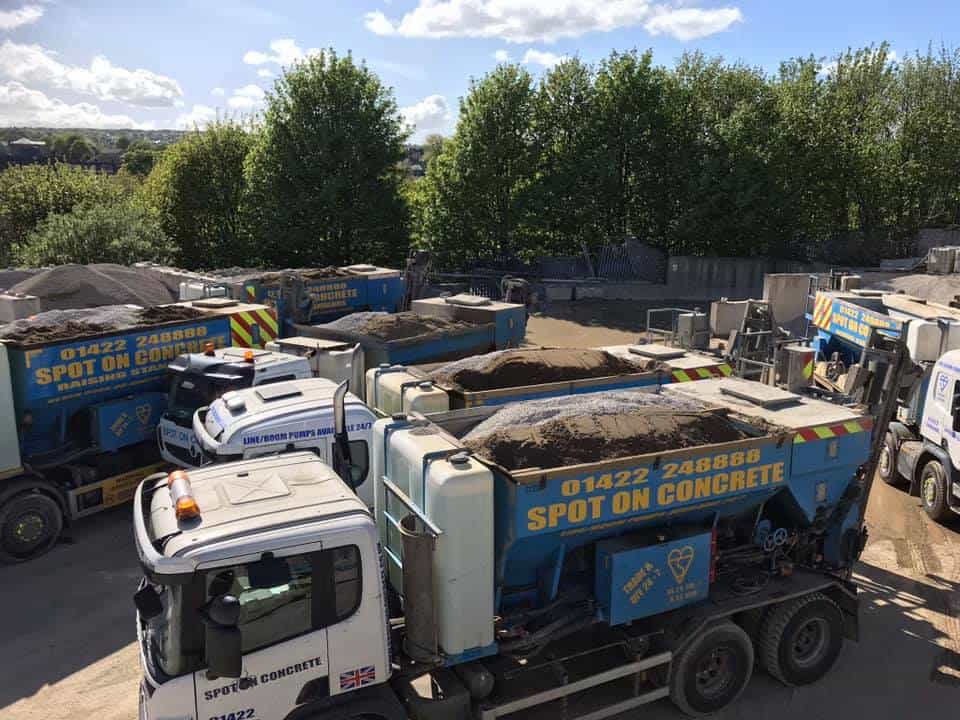
Our concrete pumping service covers projects across Yorkshire and parts of Greater Manchester. Share the details of your job so we can discuss a suitable arrangement and confirm availability.
Why combine concrete supply and pumping?
Organising both through one supplier can simplify communication about the mix, delivery time and pumping requirements. It gives you a clearer point of contact when planning how the concrete will arrive and reach the work area.
It can also help avoid a mismatch between the concrete ordered and the equipment booked. However, the scope still needs to be explicit: confirm whether your quotation includes concrete, pumping, the operator and any other agreed services.
When arranging concrete supply, tell us from the outset that pumping is being considered. We can then discuss the delivery method alongside your specification and site information.
For a closer look at arrival, setup and the pour itself, read our explanation of what happens on concrete pump hire day.
Your concrete pumping booking checklist
- Confirm the concrete specification, measured volume and planned pour sequence.
- Provide photographs, access measurements and the full route to the pour.
- Identify a suitable proposed standing area and disclose known ground hazards.
- Agree any road, pavement, parking and pedestrian arrangements.
- Confirm placing labour, equipment, protection and curing preparations.
- Arrange appropriate washout, residual material handling and clean-up.
- Check the quotation, hire period, additional charges and cancellation terms.
- Nominate a site contact and reconfirm that the work area is ready.
To discuss your next project, contact Spot On Concrete with your site location, estimated quantity and access details. We can help you assess whether pumping is appropriate and plan the concrete delivery around the work you need to complete.